You go to work expecting to come home safely. But accidents happen. A construction worker falls from scaffolding. A warehouse employee suffers a back injury lifting heavy boxes. A factory worker loses a hand to unguarded machinery. In an instant, your life changes. Suddenly you’re facing medical bills, lost wages, and an uncertain future.
If you’ve been injured on the job in Texas, you need to understand your rights. Unlike most states, Texas does not require most private employers to carry workers’ compensation insurance. This means your path to recovery may look very different from what you’ve heard about friends or family in other states. Navigating this system while trying to heal is overwhelming. But you don’t have to do it alone.

Texas Workers’ Compensation: It’s Not Mandatory
Here’s something that surprises most Texas workers. Private employers in Texas are not required to carry workers’ compensation insurance. This is a significant departure from the laws in nearly every other state.
If Your Employer Carries Workers’ Comp:
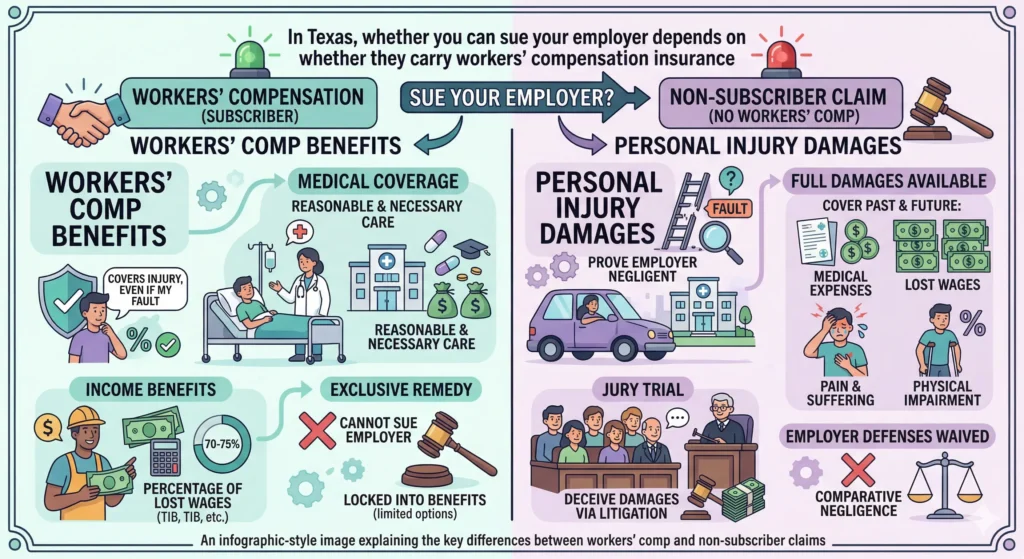
You are generally limited to workers’ compensation benefits. You cannot sue your employer for negligence. This applies even if their actions caused your injury. In exchange, you receive:
- Medical benefits. Coverage for reasonable and necessary medical treatment.
- Income benefits. A portion of your lost wages. This is typically around 70% of your average weekly wage, subject to state maximums.
- Impairment income benefits. Compensation for permanent impairment after you reach maximum medical improvement.
- Death benefits. For surviving family members in fatal accidents.
If Your Employer Does NOT Carry Workers’ Comp:
This is where Texas law becomes dramatically different. If your employer is a non-subscriber, they opted out of workers’ compensation. You have the right to sue them directly for negligence. This is a critical distinction because:
- You can recover full compensation for your damages. This includes 100% of lost wages and pain and suffering.
- There are no caps on what you can recover. Workers’ comp limits benefits, but non-subscriber cases do not.
- You have the right to a jury trial.
However, suing your employer requires proving negligence. You must show they failed to provide a safe workplace. This is why having an experienced workplace injury attorney is essential.
Common Workplace Injuries We See
Workplace injuries happen across every industry. Some of the most common include:
| Injury Type | Common Causes |
|---|---|
| Falls | Ladders, scaffolding, roofs, slippery floors, uneven surfaces |
| Back & Spinal Injuries | Heavy lifting, repetitive motion, improper equipment, falls |
| Traumatic Brain Injuries | Falling objects, vehicle accidents, slips and falls |
| Crush Injuries & Amputations | Unguarded machinery, forklifts, collapsing structures |
| Burn Injuries | Chemical exposure, electrical accidents, fires, explosions |
| Repetitive Stress Injuries | Assembly line work, typing, repeated lifting over time |
| Occupational Illnesses | Toxic chemical exposure, asbestos, silica dust, repetitive motion |
What to Do Immediately After a Workplace Injury
The steps you take immediately after an accident can significantly impact your ability to recover compensation. Here’s what you need to do:
1. Seek Medical Attention Immediately
Your health comes first. If you’re seriously injured, call 911. For less severe injuries, ask your employer about their designated doctor. But understand that you have the right to seek treatment from your own physician in many circumstances.
2. Report the Injury to Your Employer
Texas law requires you to report a workplace injury within 30 days. This preserves your rights. If you wait longer, you may lose your ability to claim benefits. Put the report in writing and keep a copy.
3. Document Everything
Take photos of the accident scene. Photograph the equipment involved and your injuries. Get contact information from any witnesses. Keep a journal of your symptoms and medical appointments. Write down how the injury affects your daily life.
4. Do Not Give a Recorded Statement Without an Attorney
Your employer’s insurance adjuster may ask for a recorded statement. Politely decline until you’ve spoken with a lawyer. Anything you say can be used to minimize or deny your claim.
5. Contact an Experienced Workplace Injury Attorney
The laws governing workplace injuries are complex. An attorney can help you understand your rights. They can gather evidence and pursue the maximum compensation available under the law.
What Compensation Can You Recover?
Depending on whether your employer carries workers’ compensation, the damages you can recover vary significantly.
If Your Employer Does NOT Carry Workers’ Comp (Non-Subscriber Cases):
When you can sue your employer because they opted out of workers’ comp, you may recover:
- Medical expenses. Past and future.
- Lost wages. 100% of what you’ve lost. This is not capped like workers’ comp.
- Loss of earning capacity. If you cannot return to your previous job.
- Pain and suffering. Physical pain and mental anguish.
- Disfigurement. Scarring, amputation, or permanent visible injury.
- Loss of enjoyment of life. Inability to engage in activities you once loved.
If Your Employer Carries Workers’ Compensation:
If your employer carries workers’ comp, benefits are limited to:
- Medical benefits. Covered, but may require pre-authorization.
- Income benefits. Approximately 70% of average weekly wage. Subject to state maximums.
- Impairment benefits. For permanent impairment.
- Supplemental income benefits. For severe, permanent injuries.
The trade-off is simple. Workers’ comp is generally faster and doesn’t require proving fault. But the benefits are capped. You also cannot sue for pain and suffering.
Third-Party Claims: When You Can Sue Someone Other Than Your Employer
Even if your employer has workers’ compensation, you may still have a claim against a third party. A third party is someone whose negligence caused your injury. Common third-party claims include:
- General contractors on construction sites who fail to maintain safety.
- Equipment manufacturers for defective machinery. This is a product liability claim.
- Other drivers if you’re injured in a work-related vehicle accident.
- Property owners where you’re working.
- Subcontractors whose negligence causes an accident.
These claims can provide compensation beyond workers’ comp. They are not limited by the workers’ compensation system. You can recover pain and suffering damages in these cases.
Texas Workplace Injury Attorneys: FAQs
What if my employer retaliates against me for reporting an injury?
Retaliation is illegal. If you are fired, demoted, or harassed after reporting a workplace injury, you may have a separate claim. Document everything and contact an attorney immediately.
How long do I have to file a claim?
If your employer has workers’ comp, you generally have one year from the date of injury to file a claim. You file with the Division of Workers’ Compensation. If you sue a non-subscriber employer or a third party, the deadline is usually two years. It starts on the injury date.
Can I choose my own doctor?
Under workers’ comp, your employer or their insurance carrier may have a network of approved doctors. If your employer does not carry workers’ comp, you generally have the right to choose your own treating physician.
What if my injury was my own fault?
Texas is a modified comparative fault state. If you were partially at fault, your recovery may be reduced by your percentage of fault. If you were more than 50% at fault, you may be barred from recovery. An experienced attorney can help navigate these rules.
Plano Workplace Injury Attorney: We Fight for Texas Workers
At Starr Law, P.C., we understand that a workplace injury affects every aspect of your life. Your health, your finances, your family, and your future are all on the line. Whether your employer carries workers’ compensation or not, we are here to help.
We have extensive experience handling workplace injury claims in Collin County and across Texas. We know how to investigate accidents. We gather evidence and build strong cases. We take action against employers, insurance companies, and third parties. We are not afraid to take your case to trial if that’s what it takes to secure fair compensation.
You focus on healing. We’ll handle the rest.
If you’ve been injured on the job, don’t wait. Contact Starr Law, P.C. today for a free, confidential consultation. Call us at 214-982-1408.
References
- Texas Labor Code, Chapter 406 (Workers’ Compensation)
- Texas Civil Practice & Remedies Code, Chapter 16 (Statute of Limitations)
Related Articles on Our Blog
- Work-Related Injuries in Texas: Your Rights and Options
- Need A Lawyer? Excellent Advice About Personal Injury Law Plano