If you or a loved one is on parole in Texas, you’re walking a tightrope. Every missed meeting, every failed drug test, every interaction with law enforcement carries the potential to send you back to prison—often without warning and without the opportunity to post bond.
The mechanism that makes this possible is called a “Blue Warrant.” Named for the blue paper they were historically printed on, these warrants are issued by the Texas Department of Criminal Justice (TDCJ) when a parole officer believes you’ve violated the terms of your release. Once that warrant is active, you can be arrested at any time—at work, at home, or during a routine traffic stop—and held in county jail with no bond, sometimes for months, awaiting a revocation hearing .
This isn’t just a legal problem; it’s a crisis that requires immediate action. The difference between returning to prison and staying in your community often comes down to how quickly and effectively you respond.
What Is a Blue Warrant?
A blue warrant is an administrative arrest warrant issued by the TDCJ Parole Division, not by a criminal court. It is triggered when a parole officer files a “Report of Violation” alleging that you have broken one or more conditions of your parole .
Once the Parole Division reviews the report and determines there is probable cause to believe a violation occurred, the warrant is issued and entered into state and national law enforcement databases. This means any police officer who runs your information will immediately know there is a hold on you .
The most devastating aspect of a blue warrant? You are generally not eligible for bond. Unlike a criminal arrest where you have a right to bail, a blue warrant detainee sits in jail pending an administrative hearing with no way to get out .
Types of Parole Violations
Understanding what you’re accused of is the first step in building a defense. Texas recognizes two main categories of parole violations .
Technical Violations
A technical violation does not involve a new criminal charge. It includes things like:
- Failing a drug or alcohol test
- Missing a meeting with your parole officer
- Failing to pay supervision fees or court costs
- Changing residences without permission
- Violating curfew
- Associating with known criminals or gang members
Many people wrongly assume that technical violations aren’t serious enough to send someone back to prison. This is a dangerous myth. In Texas, the Board of Pardons and Paroles has the full authority to revoke parole for a single technical violation .
Substantive Violations
A substantive violation occurs when you are arrested for or convicted of a new criminal offense while on parole. These are treated with the highest severity because they demonstrate ongoing criminal conduct. If you’re facing new charges, you’re fighting two battles simultaneously: the new criminal case and the parole revocation .
The 2023 Law Change: More Time to Prepare
In September 2023, Texas law changed in a way that significantly impacts how parole cases are handled. Under Senate Bill 374, the timeline for disposing of charges against a parolee was extended .
Old Law: The state had 41 days to dispose of the charges.
New Law: If you are accused of committing a new offense after release and have not yet been indicted, the state now has 90 days to dispose of the charges .
For administrative violations only, the 41-day deadline still applies. But for substantive violations with pending charges, this extended window means you could sit in jail for three months waiting for resolution—still with no bond .
The Parole Revocation Process: Step by Step
Understanding the process can help you and your attorney act strategically at every stage.
Step 1: The Report and Warrant Issuance
Your parole officer completes a violation report and submits it to the Parole Division. If they find probable cause, a blue warrant is issued .
Step 2: Arrest and Detention
You are arrested and held in county jail. The sheriff notifies TDCJ of your custody. At this point, you have the right to an attorney, but you do not have the right to a bond .
Step 3: The Preliminary Hearing
Within a reasonable time after arrest, a preliminary hearing may be held to determine whether there is probable cause to believe you violated your parole. This is not the final revocation hearing; it’s a screening to see if the case should move forward .
Important: You have the right to waive the preliminary hearing. Sometimes this is strategic, sometimes it isn’t. Your attorney will advise you .
Step 4: The Revocation Hearing
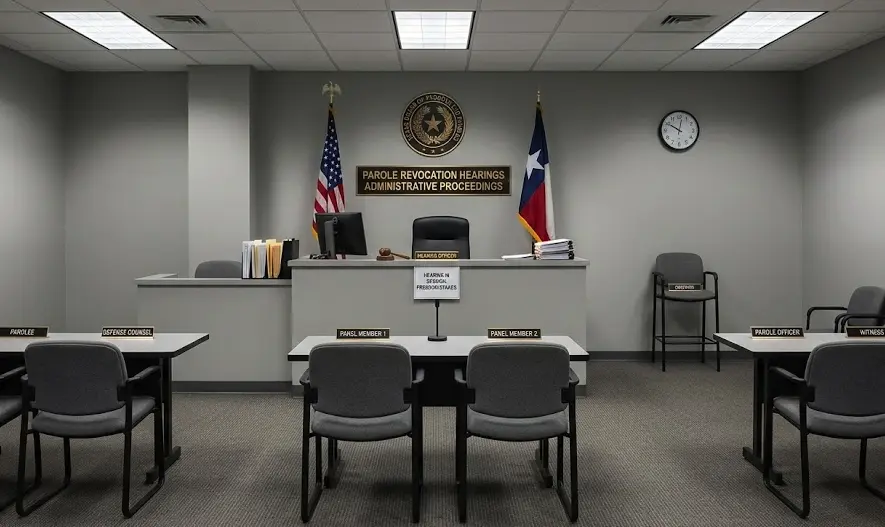
If the case proceeds, a revocation hearing is scheduled. This is an administrative proceeding, not a criminal trial. There is no jury. A hearing officer—an employee of the Board of Pardons and Paroles—presides and takes evidence .
The standard of proof is preponderance of the evidence (meaning “more likely than not”), which is a much lower bar than “beyond a reasonable doubt” .
Step 5: The Board’s Decision
The hearing officer makes a recommendation to a panel of the Board of Pardons and Paroles. That panel then makes the final decision, which can include :
- Continue Parole: You’re released back to supervision, sometimes with additional conditions.
- Intermediate Sanction Facility (ISF): Short-term lockup (60-180 days) focused on rehabilitation.
- SAFPF: Intensive in-custody drug treatment program.
- Revocation: Your parole is revoked, and you return to TDCJ to serve the remainder of your sentence.
How to Fight a Blue Warrant
Many people wait until the hearing to start fighting. This is a mistake. The time to act is the moment you learn a warrant may be issued .
Pre-Warrant Intervention
If you know your parole officer is unhappy with your behavior—maybe you missed a test or had a positive screen—an experienced attorney can often intervene before the warrant is even issued. We can present “adjustment evidence” to the parole officer or supervisor: proof of employment, negative private drug tests, letters of support, and a plan for getting back on track. In some cases, this can convince them to hold off on the warrant .
Challenging the Evidence
At the revocation hearing, the state must prove you violated your conditions. Your attorney can cross-examine witnesses, object to hearsay, and present evidence in your defense. The hearing officer’s recommendation is based on the record we create .
Mitigation: Telling Your Story
Even if a violation occurred, it doesn’t automatically mean you should go back to prison. The “mitigation” or “adjustment” phase is where we show the Board why you deserve another chance. We present evidence of :
- Consistent employment and good conduct during most of your parole
- Strong family support and stable housing
- Enrollment in counseling or treatment programs
- Medical or mental health issues that contributed to the violation
- A concrete plan for success if released
Negotiating Alternatives
Sometimes, even with a strong mitigation case, the Board is hesitant to release you outright. In those situations, we fight for placement in an Intermediate Sanction Facility (ISF) or a Substance Abuse Felony Punishment Facility (SAFPF). These are short-term, in-custody programs designed to address underlying issues—addiction, mental health, behavior—without sending you back to TDCJ for years .
Parole Violations: FAQs
Can I bond out on a blue warrant?
Generally, no. Blue warrants are not bondable. However, in limited circumstances—specifically for certain administrative violations or low-level misdemeanors—a magistrate may be authorized to set a bond. This is rare and requires that TDCJ include a notice on the warrant that you are eligible .
What happens if I’m arrested for a new crime while on parole?
You will likely face both a new criminal case and a parole revocation. The parole revocation may be deferred until the criminal case is resolved. If you are convicted of the new crime, your parole revocation becomes almost certain .
Do I have a right to a lawyer at the revocation hearing?
Yes. You have the right to be represented by an attorney at your own expense. If you cannot afford one, you may request a state-paid attorney, but these are not guaranteed in administrative proceedings the way they are in criminal trials .
What is the difference between a technical and substantive violation?
A technical violation is a breach of parole rules that does not involve a new crime (like missing a meeting). A substantive violation involves a new criminal offense. Substantive violations carry much higher stakes .
Plano Parole Revocation Defense Attorney
When a blue warrant is issued, the clock starts ticking. You have limited time to gather evidence, contact witnesses, and build a case that could keep you out of prison. Waiting only makes it harder.
At Starr Law, P.C., we have vast experience defending clients facing parole revocation in Collin County and across North Texas. We know the process, we know the players, and we know how to build a compelling case for continued release. We don’t just show up at the hearing; we intervene early, negotiate with parole officers, and fight for alternatives to revocation.
Your freedom is too important to leave to chance. If you or a loved one is facing a blue warrant, the time to act is now.
Contact Starr Law, P.C. immediately for a confidential consultation. We are available 24/7. Call us at 214-982-1408.
References
- Texas Government Code, Section 508.281 et seq. (Parole Revocation)
- Texas Government Code, Section 508.282 (Timeline for Disposition of Charges)
- 37 Texas Administrative Code, Chapter 146 (Revocation of Parole or Mandatory Supervision)
- Texas Board of Pardons and Paroles Rules
Related Articles on Our Blog
- Wrongful Convictions and Prosecutors Withholding Evidence
- DWI in Texas: 2026 Law Changes & Penalties