You have been arrested. The police filed a report. You went before a magistrate judge. Now you are waiting. You hear people talk about “indictments” and “informations.” They sound similar. They are not.
Understanding the difference is critical. It affects your rights, your timeline, and your defense strategy. In Texas, how you are formally charged depends on whether you face a felony or a misdemeanor.
Felonies require an indictment. Misdemeanors get filed by information. This is not a minor technicality. It is a fundamental protection written into the Texas Constitution.
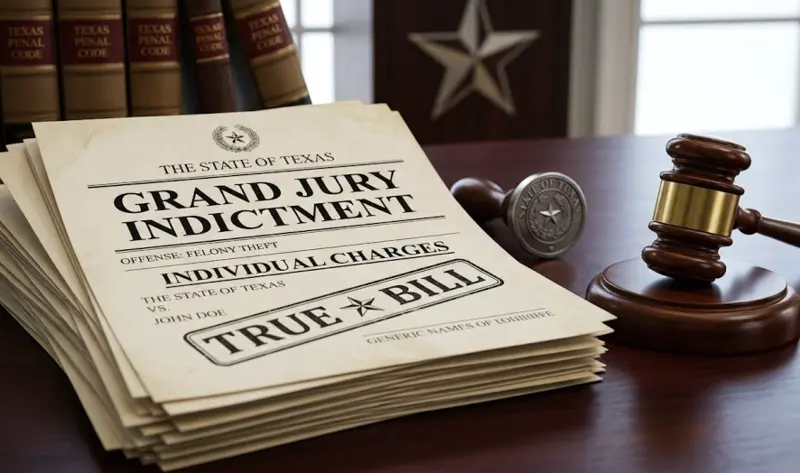
What Is an Indictment? The Felony Charging Document
An indictment is the formal charging instrument for felony crimes in Texas. It is not just a piece of paper. It is the written statement of a grand jury accusing a person of a felony offense.
The Texas Constitution is clear. Article I, Section 10 states that no person shall be held to answer for a criminal offense of the grade of felony unless by an indictment of a grand jury. This is a constitutional right. The State cannot skip this step.
How an Indictment Works
The process starts after your arrest. The prosecutor presents evidence to a grand jury. A grand jury is a body of 12 citizens selected to hear evidence in felony cases.
The grand jury listens to testimony. They review evidence. They do not decide guilt or innocence. They decide whether there is probable cause to believe you committed the felony.
If at least 9 of the 12 grand jurors agree, they return a “true bill”. This means the grand jury approves the indictment. The case then proceeds toward trial. If they do not agree, they return a “no bill”. The case is dismissed. But the prosecutor can try again with a new grand jury.
What Are the Requisites of a Valid Indictment?
Texas law sets specific requirements for a valid indictment. Under Texas Code of Criminal Procedure Article 21.02, an indictment must meet nine requisites:
- It must begin, “In the name and by authority of The State of Texas”
- It must be presented in the district court where the grand jury sits
- It must appear to be the act of a grand jury of the proper county
- It must contain the name of the accused or a reasonable description
- It must show the offense occurred within the court’s jurisdiction
- The time must be before the indictment and within the statute of limitations
- The offense must be described in plain and intelligible words
- It must conclude, “Against the peace and dignity of the State”
- It must be signed by the grand jury foreperson
If an indictment fails any of these requirements, your attorney can challenge it. Defective indictments can be dismissed or sent back for correction.
What Is an Information? The Misdemeanor Charging Document
An information is the formal charging instrument for most misdemeanor crimes in Texas. Unlike an indictment, an information does not go to a grand jury. It does not require a citizen panel to review the evidence.
Instead, an information is filed directly by a prosecutor. It must be signed by the district or county attorney. It must be supported by a sworn complaint from a credible person.
How an Information Works
The process is simpler and faster. The prosecutor reviews the case. If they believe there is probable cause, they prepare an information. They file it with the court. The case then proceeds.
There is no grand jury review. There is no requirement for nine citizens to agree. This is allowed because misdemeanors carry lower potential penalties. The constitution does not require grand jury review for misdemeanors.
What Are the Requisites of a Valid Information?
Under Texas Code of Criminal Procedure Article 21.21, an information must meet similar but slightly different requirements:
- It must begin, “In the name and by authority of the State of Texas”
- It must be presented in a court with jurisdiction
- It must be presented by the proper officer (the prosecutor)
- It must contain the name of the accused or a reasonable description
- It must show the offense occurred within the court’s jurisdiction
- The time must be before filing and within the statute of limitations
- The offense must be described in plain and intelligible words
- It must conclude, “Against the peace and dignity of the State”
- It must be signed by the district or county attorney
Notice the difference. An indictment requires the signature of the grand jury foreperson. An information requires the signature of the prosecutor. This reflects who actually makes the charging decision.
The Constitutional Right You Cannot Waive (Usually)
The Texas Constitution requires a grand jury indictment for felonies. This is not optional. The State cannot use an information for a felony charge.
However, there is one exception. Under the Texas Code of Criminal Procedure, a defendant who is represented by counsel may waive indictment. They can consent in open court to be charged by information instead. This is sometimes done as part of a plea agreement.
But your attorney will only recommend this if it benefits your case. Waiving indictment gives up a significant constitutional protection. Do not make that decision without experienced counsel.
Why Does This Distinction Matter?
Understanding whether you have been indicted or charged by information matters for several reasons.
Your Rights in the Process
With a felony indictment, you have the protection of a grand jury. Twelve citizens must find probable cause before you can be formally charged. You do not have the right to participate in grand jury proceedings. You may not even know the grand jury is considering your case. But the requirement itself is a safeguard against baseless charges.
With a misdemeanor information, there is no grand jury protection. The prosecutor makes the probable cause determination. This is constitutionally permissible because the stakes are lower.
Timeline and Strategy
The grand jury process takes time. The prosecutor must prepare witnesses and evidence. The grand jury must meet and deliberate. A “no bill” can send the case back to square one. This timeline affects your defense strategy. Your attorney may use this time to negotiate or investigate weaknesses in the State’s case.
Informations move faster. There is no grand jury step. The prosecutor files the information when they are ready. Your case proceeds to arraignment and trial more quickly.
Court Assignment
An indictment is typically forwarded to a district court or criminal district court. These courts handle felony cases. An information is typically forwarded to a county court or a misdemeanor court.
Can a Misdemeanor Become a Felony Offense?
Yes. This is an important nuance. When a person is indicted for a felony, the court has jurisdiction over any lesser included offenses. Under Article 4.06 of the Texas Code of Criminal Procedure, upon the trial of a felony case, the court shall hear and determine the case as to any grade of offense included in the indictment. This applies whether the proof shows a felony or a misdemeanor.
What does this mean in practice? If you are indicted for a felony, you could potentially be convicted of a lesser included misdemeanor at trial. For example, an indictment for felony theft might allow the jury to convict you of misdemeanor theft if the evidence supports the lower value.
But the reverse is not true. You cannot be indicted for a felony based on a misdemeanor information. The original charging document controls the potential punishment range.
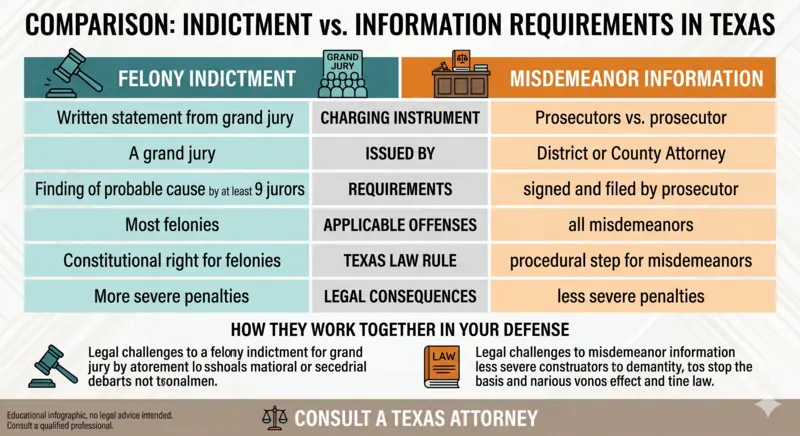
Indictment vs. Information: Side-by-Side Comparison
| Feature | Indictment (Felony) | Information (Misdemeanor) |
|---|---|---|
| Constitutional Requirement | Required under Article I, Section 10 | Not constitutionally required |
| Grand Jury Review | Yes. 12 citizens hear evidence. | No. Prosecutor files directly. |
| Vote Required | 9 of 12 grand jurors must agree | No vote required |
| Signature | Grand jury foreperson | District or county attorney |
| Supporting Document | Based on grand jury testimony | Supported by sworn complaint |
| Court | District Court or Criminal District Court | County Court or Misdemeanor Court |
| Potential Penalty | Over 1 year in prison | Up to 1 year in county jail |
Indictments and Informations: FAQs
Can I be charged with a felony without a grand jury indictment?
Generally no. The Texas Constitution requires a grand jury indictment for felonies. The only exception is if you voluntarily waive indictment with the advice of counsel and consent in open court to be charged by information.
How long does the grand jury have to indict me?
There is no fixed deadline for the grand jury to act. However, the statute of limitations applies. The State must obtain an indictment within the statutory deadline or the case is barred. For most felonies, the limitations period is 3, 5, or 10 years. Some felonies like murder have no limitations period.
What happens if the grand jury issues a “no bill”?
The case is dismissed. You are released from the charge. However, the prosecutor can present the same case to a new grand jury if new evidence becomes available. A “no bill” is not an automatic bar to future prosecution.
Do I have the right to testify before the grand jury?
No. In Texas, the accused has no right to participate in grand jury proceedings. You may not even know a grand jury is considering your case. This is a key difference from preliminary hearings in other states.
What if the indictment is defective?
Your defense attorney can file a motion to quash the indictment. This asks the court to dismiss the indictment because it fails to meet the legal requirements of Article 21.02. The court may dismiss the indictment or order the grand jury to return a corrected version.
The Statute of Limitations Factor
The statute of limitations is tied to the charging document. For misdemeanors in Texas, there is a general two-year statute of limitations. The information must be filed within two years of the offense date.
For felonies, the limitations period varies. An indictment must be presented within the statutory deadline. Some felonies such as murder, manslaughter, and continuous sexual abuse of a child have no limitations period. Others have specific time limits. Theft has a three-year limit. Arson has a ten-year limit.
Your attorney must always check the statute of limitations. If the State missed the deadline, your case can be dismissed regardless of the evidence.
Plano Criminal Defense Attorney: We Know the Process
At Starr Law, P.C., we have extensive experience handling felony and misdemeanor cases in Collin County and across Texas. We understand the grand jury process. We know how to challenge defective indictments. We know when to push for a “no bill” and when to prepare for trial.
If you have been arrested or believe you are under investigation, do not wait. The grand jury may be considering your case right now. You need an attorney who knows the system and can protect your rights at every stage.
We are not afraid to fight. We are not afraid to go to trial. We stand between you and the power of the State.
Contact Starr Law, P.C. today for a free and confidential consultation. Call us 24/7 at 214-982-1408.
References
- Texas Constitution, Article I, Section 10
- Texas Code of Criminal Procedure, Article 4.06 (When Felony Includes Misdemeanor)
- Texas Code of Criminal Procedure, Article 20A.302 (Preparation of Indictment)
- Texas Code of Criminal Procedure, Article 21.02 (Requisites of an Indictment)
- Texas Code of Criminal Procedure, Article 21.21 (Requisites of an Information)